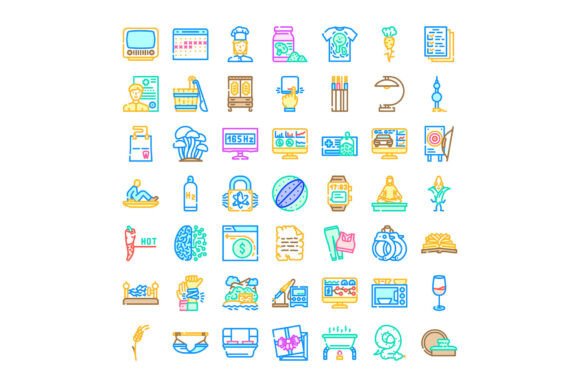
Outline Business, School, Food, and Trav: A Visual Framework for Modern Workflows
In the landscape of digital design and project management, clarity is often the most valuable asset. Professionals across industries—from educators to entrepreneurs—rely on visual systems to communicate complex ideas quickly and effectively. The Outline Business, School, Food, and Trav collection represents a specific approach to this challenge. It is not merely a set of images; it is a diverse collection of flat, colorful vector icons depicting various concepts related to business, education, food, electronics, and travel, organized in a comprehensive grid. This structure allows users to visualize workflows, categorize data, and streamline communication without the friction of inconsistent styling or overwhelming detail.
For adults aged 20 to 50 who juggle multiple roles, whether managing a startup, designing a curriculum, planning a menu, or organizing a trip, the ability to access a unified visual language is crucial. This article explores how this specific icon set fits into broader processes, how it interacts with existing tools, and practical methods for integrating it into daily routines to enhance efficiency and consistency.
The Role of Visual Consistency in Professional Planning
Before diving into specific use cases, it is essential to understand where these assets fit within a larger workflow. In any creative or organizational process, there is a phase of preparation where abstract ideas must be translated into concrete plans. This is where the Outline Business, School, Food, and Trav collection becomes operational. By providing a pre-organized grid of flat, colorful vectors, the resource eliminates the need for designers or project managers to source disparate elements from different libraries.
Consistency in visual assets reduces cognitive load. When a team reviews a presentation or a client examines a proposal, their attention should remain on the content, not on deciphering mismatched graphics. The flat design style ensures that icons scale well across devices, from mobile screens to large presentation boards, while the color palette provides immediate visual cues. For instance, using a specific shade of blue for all "Business" icons and green for "School" concepts creates an intuitive hierarchy that guides the viewer through the narrative.
This resource is particularly effective during the early stages of project definition. Whether you are outlining a semester syllabus or mapping out a supply chain for a restaurant, having a standardized set of symbols allows you to prototype ideas rapidly. You can drag and drop these elements into wireframes, mind maps, or slide decks to test the flow of information before committing to final copy or detailed layouts.
Integrating Icons into Specific Industry Workflows
The versatility of the collection lies in its coverage of four distinct yet interconnected domains: business, education, food, and travel. Each sector has unique requirements, but they all benefit from the same principles of organization and clarity.
Business and Entrepreneurial Strategy
For entrepreneurs and small business owners, the business segment of the outline serves as a foundational tool for strategic planning. These icons can represent key performance indicators (KPIs), departmental structures, or market segments. When creating a pitch deck, replacing generic bullet points with relevant vector icons can significantly improve engagement. An icon representing "electronics" might denote a tech-focused product line, while a "briefcase" symbol could highlight corporate services.
In a workflow context, these assets are used before the final execution phase. During brainstorming sessions, teams can use the grid to tag ideas, ensuring that every concept is categorized correctly. This helps in identifying gaps in the strategy. If a business plan lacks visual representation for its logistics component, the absence of a corresponding icon in the draft signals a need for further development.
Educational Curriculum and Learning Design
Educators and instructional designers face the constant challenge of making learning materials accessible and engaging. The school-related icons in the collection offer a direct way to break down complex subjects into digestible visual chunks. Whether designing a course outline for an online platform or creating handouts for a classroom, these vectors help establish a clear visual rhythm.
Integration here happens during the content creation phase. An educator might map out a module using the "school" icons to represent different topics, such as mathematics, science, or history. Because the icons are flat and colorful, they appeal to a wide demographic, from young students to adult learners in professional development courses. Furthermore, the grid organization allows for quick selection, meaning less time spent searching for assets and more time spent refining the pedagogical approach.
Food Service and Hospitality Management
In the food industry, visual communication is paramount. Menus, health safety protocols, and marketing materials all rely heavily on imagery. The food section of the Outline Business, School, Food, and Trav collection provides a consistent aesthetic for restaurants, catering services, and food bloggers. Flat icons are particularly useful for digital menus, where space is limited and load times matter.
Practically, these icons can be used to create dietary guides, allergen warnings, or step-by-step recipe instructions. For a restaurant owner planning a new seasonal menu, selecting icons that match the brand's color scheme ensures a cohesive look across all touchpoints, from the website to the physical table cards. This consistency builds trust with customers, signaling professionalism and attention to detail.
Travel Logistics and Experience Design
Travel planning involves coordinating numerous variables, from transportation to accommodation and activities. The travel icons within the collection simplify this complexity. Travel agents, tour operators, and even individuals planning personal trips can use these vectors to create itineraries that are easy to follow at a glance.
When designing a travel brochure or a mobile app interface, the use of recognizable symbols for airports, hotels, and landmarks reduces the need for lengthy text descriptions. This is especially important in international contexts where language barriers may exist. The grid layout of the collection allows planners to quickly assemble a visual timeline of a journey, ensuring that no critical element is overlooked.
Technical Implementation and Tool Compatibility
A critical factor in the long-term utility of any digital asset is its compatibility with existing software ecosystems. The Outline Business, School, Food, and Trav collection is designed to integrate seamlessly with popular design and productivity platforms. As vector files, these icons are resolution-independent, meaning they maintain crisp edges regardless of how much they are scaled. This quality control feature is vital for print media, high-resolution displays, and responsive web design.
Most modern graphic design tools, such as Adobe Illustrator, Figma, Sketch, and Canva, support vector formats like SVG or EPS. This allows users to import the entire grid or individual icons directly into their projects. Once imported, the flat design style makes it easy to modify colors to match specific brand guidelines without losing the integrity of the original shape. For non-designers, many of these icons can be pasted directly into document editors like Microsoft Word or Google Docs, democratizing access to high-quality visuals.
Efficiency is further enhanced by the comprehensive nature of the grid. Instead of downloading multiple packs from different sources, which often leads to file management issues and licensing confusion, users have a single repository. This centralization simplifies version control and ensures that all team members are working with the same assets. When collaborating on a project, everyone refers to the same visual language, reducing miscommunication and rework.
Strategic Workflow Integration Tips
To maximize the value of this collection, consider adopting a few strategic practices in your daily routine. First, establish a library system. Create a dedicated folder or cloud storage location for the Outline Business, School, Food, and Trav icons, organized by category. This ensures that when you need a specific symbol, you can find it immediately without disrupting your creative flow.
Second, develop a style guide based on the icon set. Define which colors correspond to which categories and stick to them across all your communications. For example, if you are a consultant working with both schools and businesses, ensure that your "education" slides always use the designated educational icons and color codes, while your "corporate" slides use the business equivalents. This discipline reinforces your brand identity and makes your work instantly recognizable.
Third, use the icons for internal organization, not just external presentation. Project management boards, task lists, and meeting agendas can all benefit from visual tagging. Assigning an icon to each task type helps team members prioritize and understand the nature of their work at a glance. A task tagged with a "food" icon might relate to catering for an event, while a "travel" icon indicates a site visit. This visual shorthand speeds up decision-making and keeps projects moving forward.
Long-Term Value and Adaptability
The true measure of a design resource is its longevity. The flat, colorful aesthetic of the Outline Business, School, Food, and Trav collection aligns with current design trends that favor simplicity and usability. Unlike highly detailed illustrations that can quickly date a project, flat icons remain timeless and adaptable. As technology evolves and new platforms emerge, these vectors will continue to perform well due to their lightweight nature and scalability.
Furthermore, the broad scope of the collection ensures relevance across changing career paths. A freelancer might start by using the "business" icons for client proposals, then shift to "school" icons for teaching workshops, and later utilize "travel" icons for a blog about digital nomadism. Having a versatile toolkit ready to deploy means you can pivot quickly without needing to invest time and money into new resources.
Ultimately, the integration of these icons into your workflow is about more than just aesthetics; it is about optimizing the process of thinking and communicating. By leveraging a diverse collection of flat, colorful vector icons depicting various concepts related to business, education, food, electronics, and travel, organized in a comprehensive grid, professionals can achieve a higher level of clarity, consistency, and efficiency in their work. Whether you are planning a complex business strategy or simply organizing a family vacation, the right visual tools make all the difference in turning ideas into reality.